
By Anita Graafland
Having pretty much slotted into my post-Brexit life, with seven months spent in Amsterdam and five in the UK – and not being bound by pesky rules such as three months in, three months out as my UK traveller friends to the EU are facing – I find myself slowly coming to terms with the reality that is my adopted home country outside the European Union. Reading books picking over the Brexit bones of what happened and why helps tremendously, as does attending the occasional street stall.
(At the one I attended in Launceston, I overheard a young lady telling Bev she didn’t want the country to rejoin, but rather work on its social problems right now – as in creating attractive jobs for her and her partner (both job-seekers) instead of expecting immigrants to work seven days a week for little or no pay. And here I was thinking that all young people hated the very idea of Brexit – how wrong I was!)
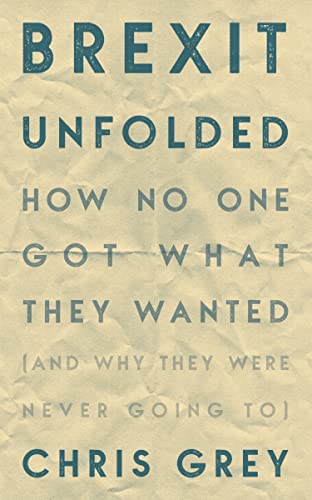
Book review is perhaps too objective a term for what I do when reading books on Brexit, as much information is of course very familiar indeed, and, as a displaced EU citizen, I’ve been very much part of the story myself. No, what I’m looking for in these accounts are answers to things that continue to baffle me. In Brexit Unfolded: How no one got what they wanted (and why they were never going to), Professor Christopher (Chris) Grey offered me one such gem, when he pointed out how the term “immigration” falsely crept into Brexit language, as people in the UK started calling EU citizens “immigrants” rather than simply fellow EU citizens who, like them, had the right to live and work wherever they wanted within the EU – a bit like calling someone from Lancashire an immigrant for moving to Yorkshire to work. I don’t think I’d heard this point made so clearly before and I’m very grateful to Chris Grey for making it.
Just like I needed Fintan O’Toole to bring home to me that there was no such thing as English culture, Chris Grey finally solved an issue for me that has had me baffled for years, i.e. why “normal people” would buy into the lies spun by the likes of Oxbridge-educated Brexit leaders, why they would throw in their lot with an elite that is so far removed from their daily lives as can be. Under the heading “The politics of authenticity”, he explains this weird phenomenon as follows (and I’m quoting at length):
“It is not that those supporters failed to spot the privilege of their leaders. It is that this isn’t the kind of privilege to which they object. Such figures […] are seen as being, despite that privilege, still in some way ‘ordinary’ or, perhaps more important, ‘authentic’. Someone ‘you could have a drink with’. […]
“Crucially, what this populist politics of authenticity means is that whilst its leaders may be highly privileged, in the literal sense of the term, they are not what their supporters mean by ‘the elite’ which, instead, is associated with the supposedly finger-wagging, ‘won’t let us say what we really think’, prissy, moralistic do-gooders. […]
“It’s an amorphous group which, together, constitutes as ‘them’ to which the ‘us’ – ordinary, common-sense people and their, perhaps not ordinary in the ordinary sense, but still common-sense, authentic leaders – are opposed. For years, this ‘we’ suffered as the ‘silent majority’, but with Brexit found its voice.”
For me, this finally explains why what I thought were like-minded people from the same backgrounds as me – and who had seemingly welcomed us with open arms – suddenly turned around and said things like “surely, the Dutch would like to leave the EU if they could?”. It was a question that left me scratching my head.
Professor Grey’s book is a very useful description of what happened and the title is spot on. Though not as enjoyable as O’Toole’s work, it was definitely worth a read. Meanwhile, I’m looking forward to any gems Gavin Esler has for me in my next what-can’t-quite-be-called-a-review recap: “How Britain ends: English nationalism and the rebirth of four nations.” Please let me know if there’s anything else you’d like me to read and share my take on.
Christopher Grey, Brexit Unfolded: How no one got what they wanted (and why they were never going to), June 2021.


