
Celebrating closer British–German ties post-Brexit
By Caroline Hager
Amid the relentless bad news, there has been precious little to cheer about as 2025 draws to a close. Yes, we can welcome the UK government’s “reset” with the EU, its belated acknowledgement of the economic damage caused by Brexit, and parliament’s first reading of a Liberal Democrat motion in favour of a customs union with the EU. These are important steps. But a long and uncertain campaign to rejoin the EU still lies ahead, while Reform UK continues to climb in the polls.
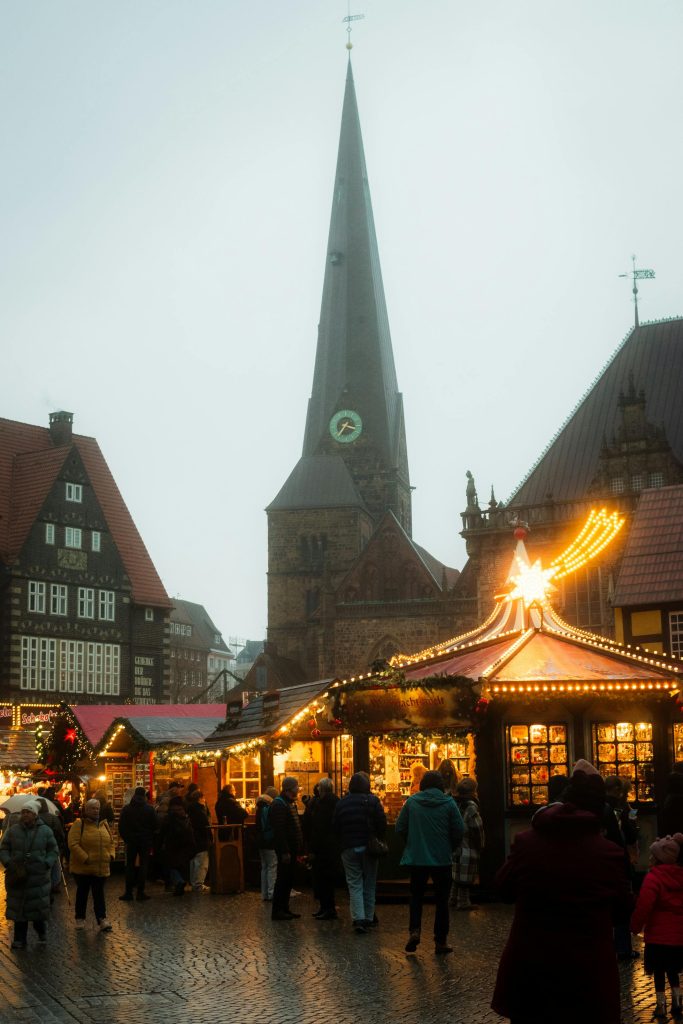
Thankfully, Christmas is around the corner, bringing with it a welcome break from the daily humdrum and political gloom. Many of us will be warming our hands on a mug of mulled wine while strolling through a traditional German-style Christmas market, before decorating the Christmas tree, a German tradition popularised in Britain by Prince Albert and Queen Victoria.
British affection for German traditions remains strong. And Germans continue to love much about Britain — particularly Cornwall, which welcomes an estimated 350,000 Germans each year, many attracted by the picturesque Cornish filming locations of the hugely popular TV adaptations of British novelist, Rosamunde Pilcher. Yet British-German economic and cultural ties were badly damaged by the Brexit disaster. Many Germans deeply regretted the UK’s decision to leave the EU and still struggle to understand why it happened. There was no schadenfreude over this act of self-harm, only sadness and confusion.
Against this backdrop, 2025 has seen a welcome rekindling of British-German relations — something that, as a Cornish-German European, I would like to celebrate. Could this signal Britain’s gradual return to the European fold?
In July, Prime Minister Keir Starmer and German Chancellor Friedrich Merz signed a friendship and bilateral cooperation agreement at London’s Victoria and Albert Museum. Known as the Kensington Treaty, the agreement responds to new challenges facing Euro-Atlantic security and aims to deepen cooperation grounded in shared history, values and interests. Across its 27 pages, the treaty lays the groundwork for concrete joint projects covering security cooperation, intelligence sharing, trade, youth mobility and exchanges, action against illegal migration, and even a new direct rail connection between the UK and Germany.
Encouragingly, the treaty’s provisions are already bearing fruit. These include allowing UK passport holders to use automated e-gates at German airports, strengthened German legislation to tackle migrant-smuggling networks, and — of particular cultural importance — visa-free travel for school and youth exchanges. Seventy years ago, thanks to the UK’s post-war openness towards Germany, my mother travelled on a “reconciliation” youth exchange from Camborne to Hamburg and became, for life, a committed European. Today’s young people must not be denied similar opportunities: exchanges like these reduce prejudice, curb nationalism and counter misinformation. In this context, the UK’s now promised return to the Erasmus+ programme is especially welcome.
The renewed commitment to Anglo-German ties was further underlined by German President Frank-Walter Steinmeier’s state visit earlier this month, which he described as the “warmest of welcomes”. Remarkably, it was the first time in 27 years that a German head of state had been received in the UK with full ceremonial honours. British and German media alike described the visit as “historic”, seeing it as a genuine effort to reset relations after the disruption caused by Brexit. The fact that King Charles III spoke in German at the state banquet was widely appreciated in Germany, where the royal family is very popular.
Although largely symbolic, President Steinmeier’s visit carried clear political messages. In his address to the British parliament — an honour notably not extended to President Trump during his September state visit — Steinmeier urged Britain, quoting Oasis, “not to look back in anger”. His appeal was for pragmatism: to move beyond Brexit and rebuild cooperation. He called for collaboration on defence, continued support for Ukraine, and stronger European unity in an increasingly unstable world. German commentators interpreted the visit as an act of reconciliation — an acknowledgement of a complex shared history and a recognition that cooperation is essential amid Russia’s war in Ukraine and wider global turmoil.
Germany remains the UK’s second-largest trading partner, and the EU’s biggest economy continues to supply the UK with machinery, pharmaceuticals, vehicles and other manufactured goods. Speaking to business leaders in the City of London, President Steinmeier called for closer economic cooperation to make exporting easier, reduce costs for consumers and deliver benefits on both sides of the Channel. While trade and investment flows remain substantial, new obstacles — customs checks and regulatory divergence — have disrupted supply chains and increased costs for firms operating between the UK and Germany, as well as across the wider EU.
In Germany, commentators broadly welcome the UK’s renewed interest not just in bilateral cooperation, but in European engagement more generally. Wolfgang Ischinger, former German diplomat and Chair of the Munich Security Conference, recently remarked on German television that Brexit was now widely recognised as a “disastrously failed experiment”. In his discussions with British and European leaders, he observed, most now regret Brexit and are searching for pragmatic ways to repair the damage. Such assessments offer at least a glimmer of hope for the future of the UK’s relationship with Europe.
My Cornish mother was still alive and deeply saddened by the UK’s, and Cornwall’s, decision to leave the EU in 2016. Last week, as I wandered through Aachen’s festive Weihnachtsmarkt with my German father, surrounded by the smells of Glühwein and Bratwurst, I heard English voices exclaiming over the wonderful Christmas spirit in Germany. The rekindled friendship between my two countries fills me with genuine Christmas cheer.


