
By Bev Haigh-Jones
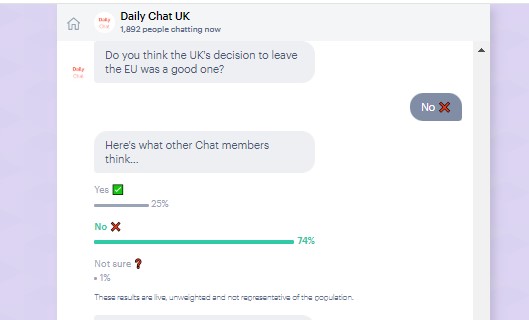
Image taken from a YouGov poll
I’ll start this time with some positives related to the EU. Recent months seem to have brought a renewed vigour to the pro-EU movement with successful campaigns, prominent people speaking out and more people joining pro-EU organisations. I don’t want to repeat what I have said in the Campaigns feature, but I would like to emphasise the apparent rise in those who recognise Brexit for the disaster that it is and want to change it.
Sadiq Khan, always someone who speaks out for what he believes, has added to his recent report on the cost of leaving the EU by calling for a scheme which would allow our young people to travel more freely within the EU. This dovetails nicely with two campaigns currently being run by the European Movement, “Embrace Erasmus+” and “Face the music”, the latter a campaign also being supported by Professor Brian Cox. Another long-standing champion of the EU and committed Anglophile, Guy Verhofstadt, also spoke out recently, citing the appointment of David Cameron as Foreign Secretary as a possible positive step and asking “Why not rejoin?” This sentiment seems to be echoed by the majority of the UK population, a fact demonstrated very well by the polling site Wethink. They run a dynamic, ongoing graph of opinion which can be broken down in a variety of ways, including by age group, political party and even Red Wall area, and it is interesting to see that almost every grouping is in favour of rejoin, apart from those in age groups above sixty-five years.
Of the many others who are continuing the push for the UK to again be part of the EU, Mike Galsworthy, Chair of the European Movement, has been very active recently. Not only did he take part in a long interview with The Standard which resulted in a good article, but he also endured a session on GB News on the fourth anniversary of Brexit, talking with Nigel Farage and David Davis – just the thought is enough to make one’s toes curl! Also on GB News on anniversary day, Jacob Rees-Mogg bit off a little more than he could chew when he chatted with a Kent farmer who, far from celebrating Brexit, proceeded to outline the problems it has caused.
Now we move to government-related issues. And we can’t really have that without some mention of the forthcoming election, whenever that might be. Firstly, having announced recently that expats who had been out of the UK for over fifteen years would again be able to register to vote, this article in The Guardian tells us that the Tories have hired a coordinator to encourage them to take part. Presumably, they felt that expats were likely to be Tory supporters, but that assumption is not supported by the Daily Mail, who think the Tories will be punished, or Yorkshire Bylines, who suggest “Conservatives face backlash”. Meanwhile, Jolyon Maugham of the Good Law Project raises questions over the planned proxy voting system that has been put in place, as it seems to be at odds with the government’s supposed wish to have voter ID. As for domestic voting, the Mirror goes so far as to suggest that the government are “Rigging General Election rules”. Given that the Electoral Commission say it is like “telling the umpire how to enforce the rules of the game”, one would tend to agree.
This isn’t the only suspect activity taking place within government, of course. At a recent GB News event, Sunak People’s Forum, the response from one of the audience as they left seemed to indicate that they were offered expenses to attend the gathering. We have also seen a report recently in The Guardian of water company bosses and the chairs of Ofwat and the Environment Agency dining at an exclusive club – presumably at tax-payer expense – not to discuss how they can best resolve the appalling state of our sewage system, but how they can placate customers who object to price rises! Moving on to our health service, despite what Rishi Sunak and others would have you believe, the NHS has all but collapsed over the time the Conservatives have been in office, and waiting times are not improving. The London Economic cite a recent Channel Four investigation in their article and show a video with a frightening graph on the statistics, plus Marina Purkiss shared a startling graph on “X”, which was from John Burn-Murdoch of the Financial Times. It also seems the unease is not just with the public, but perhaps within the ranks as Mandrake of the New European claims inside sources have said that David Cameron is “having second thoughts” about his new role, is unhappy with Sunak’s approach to international politics, and is likely to be gone before the next election.
Worries over the actions and integrity of government go far deeper, though, than a suspect dinner at a club, whether they are misleading us about the NHS, or whether Sunak has too little interest in foreign affairs. Elder statesman Ken Clarke recently voiced his concerns over the direction which is being taken, warning that we risk becoming an “elective dictatorship”. This opinion is mirrored in an article by The New Statesman – The Rotten State and the excellent Led by Donkeys give us some facts about recent appointees to the House of Lords and their suitability (or otherwise) for the role.
Given all of the above, I just wanted to finish this section by saying that, in my opinion, what this country needs is to get the younger generation fully engaged with politics, to the extent that they realise what is happening to their futures and they find the voice to let their views be known. This was really brought home to me by an inspiring speech by a young man in the USA – obviously well informed, passionate about his country and eloquent in expressing his views. Every country needs young people like this to fight for their rights and their future.
Now, a little on environmental issues – some good, some not so good. Firstly, the not so good! We are all aware, I’m sure, that there have been numerous impacts on the UK fishing industry as a result of Brexit. We may not be aware, however, that other countries have also been impacted and not in a way that is good for our climate. A recent study suggests that changes that have been imposed on Norway’s mackerel fishing fleet have doubled their carbon footprint.
On a more positive note, there was an excellent webinar recently, organised by London for Europe, called “EU Environmental Policy – Its relevance post-Brexit”. If you haven’t seen it and would like to watch it you can access the video here. You will also need the passcode: B5v&V%0N
Finally, could this be an option for Cornwall? Or indeed for the UK as a whole? Cornwall farmland is fast disappearing under solar farms and more are planned – a necessity to save the planet you might say – and I wouldn’t disagree. However, wouldn’t it be a better option to adopt floating solar farms? Installing these on our reservoirs has numerous advantages over land-based installations, as explained in the video.
And, as usual, our Cornwall section finishes the roundup. Sad news recently as it seems that new ferries will not be all plain sailing for the Isles of Scilly. The £48.5m of Levelling Up Funding may well be withdrawn by the government if the Isles of Scilly Steam Ship Company proceed with a privately-funded option, meaning that fares could increase significantly for islanders and visitors alike. Bad news also for Hayle when it was announced that Corinthian, the developer of the North Quay Housing Project, has gone into administration. There was much opposition to the project, but given the stage it has reached, I’m sure that everyone will be hoping that a package can be put together to complete the build.
I’ve already touched on the problems with the NHS earlier in this article, but the impact of the crisis is being felt heavily in Cornwall. Yet again, the Royal Cornwall Hospital Trust declared a critical incident at Treliske on Sunday 21 January and this situation was duplicated at Derriford Hospital in Plymouth, which would normally be our next port of call. Having had a very close relative in Treliske throughout the week preceding this incident, I saw first-hand the pressure that exists within the hospital. People being treated on trollies, up to ten in a side room meant for consulting, people waiting for admission spending the night on chairs in corridors, shortages of basic equipment such as stands for intravenous fluids (the solution being to tie it to an overhead light with a rubber glove!), only one pillow to a bed allowed because they don’t have more, etc. No surprise to me that NHS staff are leaving in high numbers. Of course, Rishi Sunak paid a visit to Cornwall very recently to publicise his new NHS Dental Recovery Plan, amongst other things. However, he managed to commit something of a faux-pas in that he visited a dentist that is not taking any new NHS patients over the age of 18.


Floating solar is a great idea, for the reasons mentioned in the BBC item linked in the text. There is also an example in UK which is mentioned in this film (which I highly recommend) at about 12 minutes in: https://climateracefilm.org
As regards putting solar on the land, well the choice between farm and solar farm may not have to be made. A growing field (sorry) is ‘agrivoltaics’, in which some sort of farming is done underneath elevated PV solar panels. So the ground is used twice and some crops seem to grow better under the solar panels. Another option being researched at the University of Greenwich is putting solar panels on to polytunnels.
There is much talk of rewilding and planting species that provide food for pollinators – all good. But I’m wondering whether covering such areas in PV solar would also be beneficial. As summers get hotter, wild creatures (all sorts) might appreciate the shade given by the solar panels. Now there’s a research project waiting to be done!