
By Ann Higgins
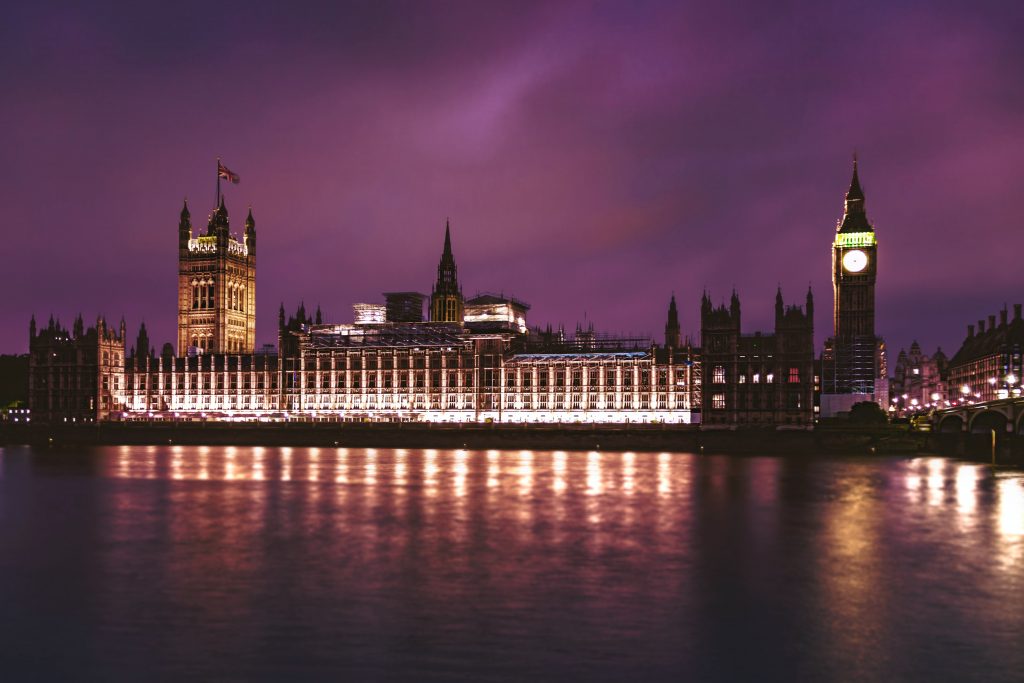
Photo by deniz-fuchidzhie on unsplash-Westminster-at-night
After the excitement of the first few weeks of this year, Parliament has gone relatively quiet. Though it went through with very little publicity, perhaps the most significant vote was on the Electoral Commission and Policy Statement which was approved by both Commons and Lords despite the strongly worded statement by the Electoral Commission here. As the statement explains, “The Elections Act 2022 includes provision for the UK Government to designate a Strategy and Policy Statement for the Electoral Commission, setting out the Government’s priorities relating to elections and the roles and responsibilities of the Commission in enabling the Government to meet those priorities. The Commission must have regard to any such Statement and report on this duty to the Speaker’s Committee for the Electoral Commission”.
Despite reassurances by the government that the Electoral Commission needs only to “have regard” to any such statement, there is serious concern that it interferes with the independence of the commission and that it has already undermined public confidence in it. As with the introduction of voter ID, there’s no evidence that it is at all necessary or desirable. As asked in the Commons Debate by Clive Betts, Labour MP: “Either it seeks to change how the Electoral Commission operates, in which case it is interference with an independent body, or it does not seek to do that, in which case what is the point of it?”
Further news on the election front, this time about the spending allowed by each political party during elections. With virtually no notice, the government has introduced a statutory instrument raising the cap by a whopping 80% from £19.5 million per party to £35 million. Could this possibly be connected to the fact that in the third quarter of 2023, the Tories raised over £15 million and the Labour Party £3 million? I couldn’t possibly comment.
Back now to Rwanda and the Safety of Rwanda Bill which, having been given its third reading by the Commons on 17 January, moved swiftly to the Lords where it has now reached its committee stage. Before that, however, it was the subject of a most unusual motion aimed at delaying the Bill by refusing to ratify the treaty with Rwanda which underpins it. This was carried by 214 votes to 171, the cross-party majority agreeing with Lord Goldsmith that the treaty should not be ratified until the measures that were required by the Supreme Court to make Rwanda safe are in place. Perhaps not surprisingly, that did not deter the government, and, having received its second reading on 22 January, the committee stage commenced on 29 January with the debate on a number of amendments. These were proposed by Labour peer Baroness Chakrabati and supported by the Archbishop of Canterbury, the Bar Council, the Joint Parliamentary Committee on Human Rights and the House of Lords (HoL) Committees on International Agreements and the Constitution. In fact, it would be much quicker to recite those who support the Bill, i.e. Tory peers and by no means all of them. These debates will be followed towards the end of February by a series of votes when we will learn whether or not their lordships will have the courage of their convictions and pass these amendments or bend to the will of the Commons. Watch this space.
Last but not least, what looks like an extremely interesting report on the lessons not learnt in the 2015, 2017 and 2019 general elections, penned by the Electoral Reform Society. I’ve yet to read it myself but what they produce is usually well worth reading. Why not use our comments section to let me know what you think about it?


