
By Chris Davey
Last month’s Still European contained an interesting “snippet” highlighted by Bev Haigh-Jones: the increase in carbon emissions from airlines as a result of the Ukraine war. I had not joined those particular dots, so it was useful to follow the link to The Conversation and read how airlines, forced to avoid airspace around some of the current conflicts, made substantial detours, resulting in an estimated increase in carbon emissions of between 18% and 40%.
It’s important to remember that the climate impact of aviation is not limited to just carbon dioxide; other factors may result in a doubling of the effect when expressed as CO2e (carbon dioxide equivalent), e.g. soot particles and contrails add to warming. Though short-haul flights have a higher emission per passenger kilometre than long-haul (all that energy expended in getting up to cruising altitude, only to come down to the ground again a bit later), clearly long flights add most greenhouse gases to the air, and so at the present time, even more such emissions. Personally, I have signed up to FlightFree UK and pledged not to fly again until it can be made genuinely zero carbon (e.g. the Heart Aerospace project which I highlighted in December); so it looks like I’m not going to fly anywhere for a few years. Never mind, with high-speed and sleeper trains enjoying a resurgence in Europe, there is plenty of scope for visiting “the mainland”, which would probably be my choice rather than more distant destinations.
The extra mileage flown to avoid conflict zones is of course not the only, or indeed the worst aspect of war. In addition to the suffering and death that are the inevitable, horrific impacts of war, direct carbon emissions are produced, in quantity, and are under-reported since the stats generally exclude military activities. In Ukraine, Gaza, Syria, and elsewhere in war zones, not only have people been killed and injured, but also displaced because their homes have been destroyed. Rebuilding will be in each case a colossal undertaking, which will mean demand for much concrete… which happens to be a very carbon-emitting substance to manufacture. As if war itself were not bad enough, the rebuilding in the aftermath will release masses of greenhouse gasses in the future, irrespective of who “wins” these conflicts.
And that got me thinking about ways the stats might be otherwise obscured. An obvious one is the habit of quoting “territorial” emissions, i.e. those produced within the country in question. That is arguably a misleading metric, since additional emissions are released by the manufacture of imported goods, and it may be more accurate to quote emissions based on consumption. Every time we buy something bearing the label “Made in China”, we have in effect exported a small percentage of our personal carbon footprint across the globe.
Then there is under-reporting; a Washington Post article published around the time of COP 2021 in Glasgow pointed out that there is a gap between the emissions that countries reported to the UN, and GHGs in fact being emitted. Numerous COP targets have been missed and, if the emissions that are on record are underestimates, then our task in meeting those targets is even harder.
Sea level rise is a well-known effect of climate breakdown; when ice from the polar regions melts, it has nowhere else to go but into the sea. But an often overlooked phenomenon is the thermal expansion of water; having many cubic kilometres of water rise even slightly in temperature implies a massive increase in volumes. So the warmer the oceans get, the “bigger” they are, and the more sea levels will rise. More detail from NASA.
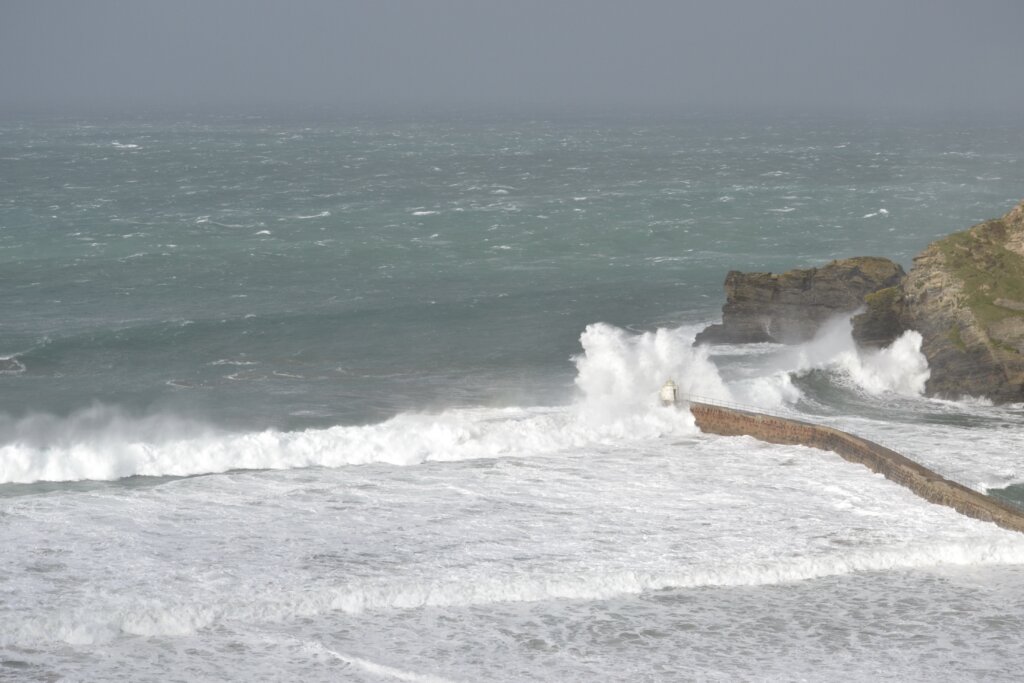
This is indeed one of the consequences of increased sea temperatures that affect our coastline here in Cornwall. A few centimetres rise in sea level doesn’t sound too serious; but the rise in level also implies that the tides come further inland than before, and along with storm surges, the coast gets battered and sometimes chunks of it fall into the sea. A further factor is that heavier rain in the storms adds to the fragility of the cliffs. Being well aware of this issue, Cornwall Council has various initiatives to plan for and mitigate future coastal erosion, of which an example is the Long Rock Coastal Improvements project — which I’ve shamelessly picked out because it benefited from EU funding!
Sources for this article include The Washington Post, The Conversation, The Climate Book, Cornwall Climate Stories (Living On The Edge), NASA.


