
By Jeremy Menadue
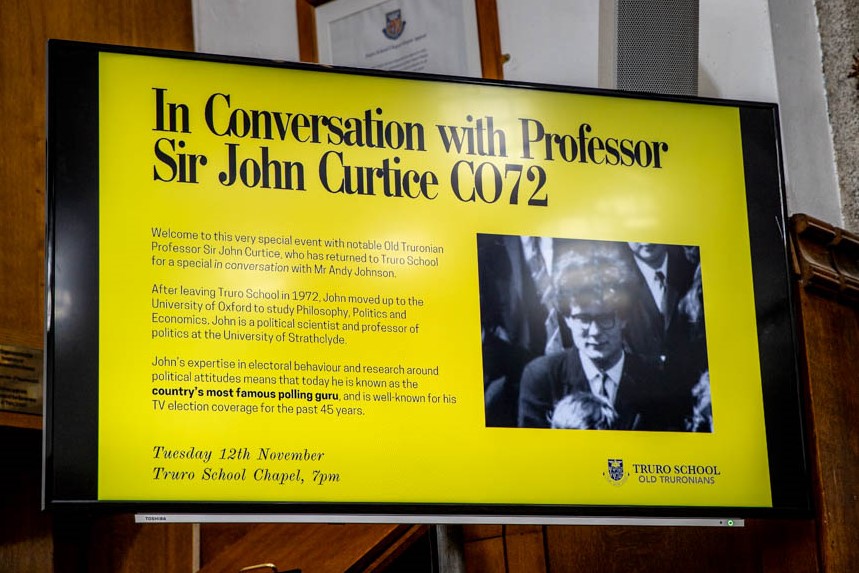
Last week Professor Sir John Curtice returned to his native Cornwall for an enthralling talk about his life, career and the nature of his work as a political scientist.
He should seem familiar to all of us from his ever-present punditry at just about every General Election I can remember and, even if the result went the wrong way, (for me often!) there was something reassuring about hearing his calm explanations of the shifts in public opinion and the reasons for margins in victory and defeat.
The first part of the talk was fascinating, covering his very early influences in politics, being allowed to stay up for election results past his usual bedtime from eight years old and up.
I wondered whether that was when he started to think about why people voted the way they do. We were told how his questioning spirit was allowed, maybe even encouraged by his education at Truro School as a direct grant scholarship pupil, leaving in 1972. (Two months before the writer of this article turned up under the same scheme.)
After the biographical stage, Sir John answered pertinent questions from the host Andy Johnson, Headmaster of Truro School, who made Sir John pause at times. Gradually, the audience had questions of their own ready and Sir John was impressive in the way he answered the ones concerning polling and interpretation and sensibly disarmed any that were overtly political.
His account of Trump’s recent victory was persuasive, and I remember the care he took to explain the course of the earlier Scottish independence referendum.
What struck me was his modest insistence that he had no real power, no authority to impose but a genuine commitment to remain a neutral commentator. Of course, sometimes that meant he would be explaining why something happened that would contradict official verdicts!
Among the final questions was the perennial problem of first past the post versus proportional representation – I don’t think that was resolved! All in all, a deeply thoughtful event and the full house in the chapel had much to ponder over. Many thanks to Professor Curtice for his time and calm, often wry account of some of the great deal he does.


