
I was the Commander Road Policing
By Ken Pennington
I was the Commander Road Policing (Rural) for the Police Service of Northern Ireland from February 2006 through to April 2008. What has that got to do with Brexit? In addition to road safety, this role involved countering organised crime and cross-border smuggling (this included the establishment of the BALTIC team, Border and Level Two intelligence and crime). This covered all of the international border between Northern Ireland and the Republic of Ireland. I started my career in South Armagh in 1987 to 1990, back when it was a bit “spicy”.
When the Brexit disaster came in, I was on my way to University College Cork from Northern Ireland. Frankly, I was stunned. The issues:
- Irish citizens (and UK) already benefited from the Common Travel Agreement across the islands, prior to EU membership.
- The border is approximately 499 km (310 mi) with an estimated 300 road crossings (not to be confused with where you can just cross). The maritime borders remain disputed.
- Operation Yellowhammer stated – A hard border between Northern Ireland and the Republic will be likely.
- In 2018, Jacob Rees-Mogg’s European Research Group was advocating a “technological” solution to monitoring traffic on the international border. I believe there was some comparison at the time with Norway and Sweden. Let me be clear, that border is not the same. Any technological infrastructure will most likely be destroyed by some form of bulldozer that has been stolen. Anyone who goes to replace it will require a bomb disposal team. I provided information to this effect to the Institute for European Peace Studies in 2018.
- The Counter Terrorism and Security Act (UK) 2019, “Confers power on examining offices (that is, police constables and designated immigration and customs officers) to stop, question, search and detain persons at a port or border area for the purpose of determining whether they are, or have been involved in hostile activity.” It continues. “This provision will apply across the United Kingdom and could be used at any port or airport, within one mile of the Northern Ireland land border and at the first place at which a train travelling from the Republic of Ireland stops in Northern Ireland where passengers leave the train.” This will disproportionally impact upon border communities, who are mostly “nationalist” and strongly voted against Brexit. If implemented, the use of this legislation would provide a narrative for those still supporting terrorism in a post-conflict society.
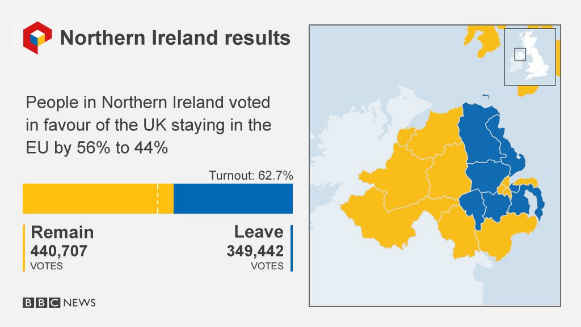
- Ultimately these problems resulted in the “Irish Sea border,” which is deeply offensive to Unionists, however, it is easier to control ports than the frankly uncontrollable land border.
In consequence, Brexit opened old wounds that the Good Friday Agreement of 1998 sought to resolve. It provided no benefits, and any solution will inevitably leave one part of the divided community that is Northern Ireland dissatisfied and disgruntled.


