
By Chris Davey
[Throughout this piece, by “EV” I mean battery electric vehicle]
One day in 1996, I sat down at my desk on the first morning of a new job. A member of the secretarial team arrived to show me around my computer, different from the old MS-DOS one I had been used to; this one had email! It took me just a few minutes to decide that email was what I had been waiting for. Fast forward about 25 years and something similar happened. I decided to test drive a Nissan Leaf. In that case, after about a half a mile, I realised this was far and away the best car I had driven since passing my test in 1968, and I had to have it. Six years later, my opinion of it has not changed. And, of course, I’m glad it is climate-friendly; if it weren’t, I’d have a real dilemma.
It’s surprising to me that, in 2026, some folks are still querying whether the electrification of transport is a good thing; as though we could carry on burning fossil fuels and let the planet’s temperature rise indefinitely. One common objection is that EV manufacture requires more energy than for a fossil fuel car, especially for the battery, and so produces a lot of carbon emissions (unless of course the energy is from renewables). It’s been said the best place to make EVs is a sunny desert, e.g. California, and the worst is a country still heavily dependent on coal for its electricity.
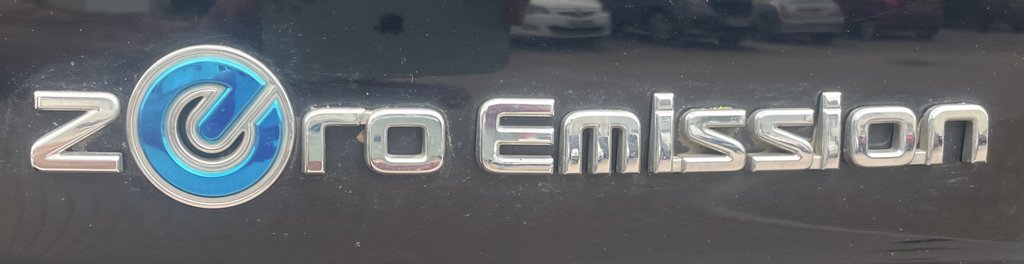
Detractors also point out that calling EVs “zero emission” is misleading because of those emissions produced during manufacture. I have to say, when I saw that wording on the back of my Leaf, I thought Nissan had been a bit cheeky. But of course making any vehicle, electric, diesel, petrol, hydrogen or whatever, will need materials and energy and will give rise to emissions. They might have said “zero emissions from the car while being driven – emissions incurred during manufacture steadily being paid back”, but that’s probably a bit much to put on to the tailgate. In any case, if it were only a case of transferring the emissions somewhere else (which of course, it isn’t), that would arguably be a win, as some ten million people die across the world every year from outdoor air pollution, much of it roadside, and many more are made ill. So simply moving the pollution from the road to some power station, reduces the “intake fraction”, that is the amount of pollution a person is likely to experience – a good thing.
But in any case, from the first drive, EVs begin to pay back that energy and carbon. It depends on the manufacturing process how long the payback time is, as well as how the car is driven, weather conditions, and, of course, the energy source for charging the car. Payback time for the extra emissions compared with a fossil fuel vehicle has been estimated at around two to three years on average. Note also that EVs require less energy in use anyway, since engines that burn hydrocarbons waste, as heat, about 65-75% of energy input, whereas EVs simply turn the electrical power into motive power with high efficiency – and that electrical energy may be renewable if charged from home solar or wind – or at least lower carbon, if charged from the grid overnight.
Then there’s the “EVs are heavier” argument, meaning more tyre, brake and road wear, and the spectre of multi-storey car parks collapsing under the weight. Like for like, yes an EV version of a petrol or diesel model will be heavier; but time now for a bit of nuance… the useful metrics here are unladen mass (“kerb weight”), and gross vehicle mass (GVM), which is the upper limit for a fully loaded vehicle. The GVM of my EV is lower than the unladen mass of a large diesel SUV; and anyone looking for bad guys should turn their attention to obese internal combustion engine (ICE) vehicles rather than average EVs. And our car has about the same mass and acceleration as a BMW 3-series turbodiesel. I mention that point because the acceleration is also cited as a negative aspect of EVs, as strong acceleration and deceleration tends to increase tyre wear, meaning tyre fragments released into the air – well, EVs certainly shift, but that doesn’t mean that EV drivers always leave rubber on the road and smoke in the air when they see a green light. And in terms of deceleration, EVs use regenerative braking, which means the motor flips into being a generator and takes kinetic energy from the moving vehicle and puts it back into the battery. This is of course an energy- and range-saving measure, but also means braking is gentler, with less use of the friction brakes, so that also means that brake dust emissions are reduced.
But not everyone can afford to buy an EV; certainly those on low incomes and in housing where home charging is problematic, affordability of charging can also be a challenge. Yet another reason for making public transport more affordable, reliable, safe and convenient. However, you can now get a new EV with a real-world range of over 200 miles for under £30k; and the running cost savings begin with the journey home from the dealership. Of course for those folks who are struggling with the cost of living crisis buying a £30k car is impossible, but there are pre-owned EVs on the market that are more affordable, e.g. a 50k+ mile Leaf for around £5k, or a Zoë for around the same. It’s worth remembering that these are better options than a similarly age and mileage ICE car as electric cars are lower maintenance and battery life is far better than was envisaged it would be back in the 2010s.
Yes, we all need to be walking and cycling more, and taking the tram/bus/train (but not plane) wherever possible. I remember hearing Friends of the Earth saying this in the 1970s, and it has been said many times since. But people like to have a car, and, to be fair, asking them to change to a different type of car feels to me less demanding than some of the other lifestyle changes that are recommended to cut their carbon footprint.
**********************************************************************
Sources and suggestions include:
The Climate Book, compiled by Greta Thunberg (air pollution info from Drew Shindell of Duke University, North Carolina, writing in The Climate Book.)
Books by Mike Berners-Lee, notably How Bad Are Bananas, A Climate Of Truth.
[Still] No Miracles Needed, by Mark Z Jacobson: revised version 2026
https://www.seedling.earth/lesson/10-actions-you-can-take-to-reduce-your-carbon-footprint
https://ukelectricityprices.co.uk/carbon
© Chris Davey 2026


